Insights
VWO vs Optimizely: Which A/B Testing Tool Fits Your Team?

Choose VWO if your team is marketing-led, mid-market, and needs fast time-to-first-test with built-in behavioral analytics. Choose Optimizely if you run an engineering-led organization that needs mature feature flags, CI/CD integration, and a sequential Stats Engine built for high-volume experimentation at scale.
- VWO bundles heatmaps, session recordings, and funnel analysis natively, so marketing teams avoid paying for separate tools like FullStory.
- Optimizely uses a sequential Stats Engine that lets you peek at results without inflating false positive rates — a real advantage for teams running many concurrent experiments.
- Pricing risk: Optimizely’s quote-based model carries reported renewal increases of 15–25%; VWO publishes tiered pricing publicly.
Pro Tip: Before committing to either platform, map your team’s ratio of marketers to engineers. That single ratio predicts which platform will actually get used.
Table of Contents
- How VWO and Optimizely compare on core experimentation features
- Which platform gives you better behavioral analytics out of the box?
- How much engineering effort does each platform actually require?
- Who should actually use each platform?
- How do the integration ecosystems compare?
- What does support and onboarding look like for each?
- Security, compliance, and performance considerations
- What do customer reviews actually say?
- Real-world use cases across industries
- How each platform handles high-traffic scale and reliability
- Data privacy policies and user data handling
- Product roadmap and update frequency
- Key Takeaways
- The case for choosing a platform vs. choosing a partner
- Quantum3 handles the experimentation work your team doesn’t have time for
- Useful sources for deeper buyer diligence
How VWO and Optimizely compare on core experimentation features
| Dimension | VWO | Optimizely |
|---|---|---|
| Best for | Marketing and mid-market teams | Engineering-led enterprises |
| A/B and multivariate testing | Visual editor, client-side | Visual editor + SDK |
| Personalization | Built-in targeting rules | Advanced, CDP-connected |
| Server-side / feature flags | VWO FME (growing) | Mature, CI/CD-ready |
| Behavioral analytics | Native heatmaps, recordings | Requires third-party integration |
| Pricing transparency | Public tiered plans | Quote-based, no public list |
| Renewal risk | Low | 15–25% increases reported |
| Implementation time | Days to weeks | 4–12 weeks depending on scope |
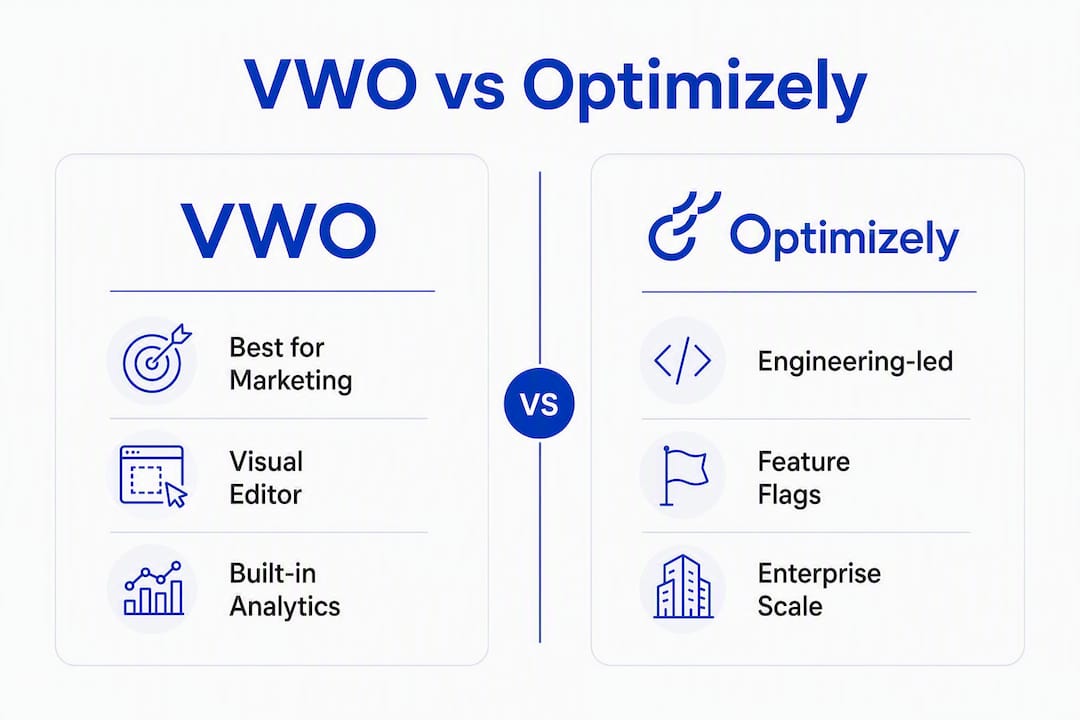
VWO covers A/B, multivariate, split URL, and personalization tests through a single visual editor that most marketers can operate without developer help. Optimizely matches those client-side capabilities and extends further into server-side feature experimentation with SDKs across Python, Java, Go, Swift, and more.
VWO FME now offers server-side testing and feature flags, but Optimizely’s feature management remains more mature for enterprise CI/CD workflows. If your roadmap includes gating features behind experiments tied to deployment pipelines, Optimizely is the stronger technical fit.
Which platform gives you better behavioral analytics out of the box?
VWO’s clearest advantage is what it includes by default. Heatmaps, session recordings, and funnel analysis ship with the platform, so your team gets qualitative context alongside experiment results without a separate subscription.
Optimizely takes a different approach. Its core product focuses on the experimentation engine itself, and teams that want session replay or click-map data typically integrate FullStory or Contentsquare. That integration works well technically, but it adds cost and a second vendor relationship. Because VWO bundles these tools, Optimizely teams often pay more in total once third-party behavioral analytics are factored in.
Crazy Egg is worth mentioning for smaller teams that want simple heatmaps and click-tracking without a full experimentation stack. It covers visual analytics at a lower price point, though it lacks the depth of either VWO or Optimizely for running structured experiments.
How much engineering effort does each platform actually require?
VWO’s visual editor lets a marketer build and launch a client-side A/B test in hours. The JavaScript snippet installs via Google Tag Manager, and most teams reach their first live test within a day or two.

Optimizely Web Experimentation follows a similar client-side path, but server-side Feature Experimentation is a different commitment. Full SDK integration typically runs 4–8 weeks for web experimentation and 8–12 weeks for feature experimentation with deeper CI/CD work. Plan engineering sprints accordingly, and budget for implementation services that can add significantly above the subscription fee—expect $20K–$120K depending on deployment scope.
For teams without dedicated engineering bandwidth, that gap is decisive. VWO’s lower implementation barrier means experiments start sooner and the platform earns adoption faster.
Who should actually use each platform?
VWO fits marketing teams at SMBs and mid-market companies that want to run experiments without filing engineering tickets for every test. The visual editor and bundled analytics reduce the need for engineering support and shorten the path from hypothesis to data.
Optimizely fits large engineering-led organizations where product managers and developers collaborate on feature releases, and where governance, audit logs, and CI/CD integration are non-negotiable. Optimizely’s dual audience — marketers and engineers — often produces polarized reviews because the two groups get meaningfully different experiences from the same platform.
AB Tasty occupies a useful middle ground for European and mid-market brands that want personalization features alongside testing, with more commercial flexibility than Optimizely’s enterprise contracts.
How do the integration ecosystems compare?
VWO connects with Google Analytics 4, Segment, Mixpanel, HubSpot, Salesforce, and most major tag managers. Its analytics integrations cover the tools mid-market teams already use.

Optimizely’s ecosystem is broader at the enterprise tier. It integrates with CDPs like Segment and mParticle, data warehouses, and the full Optimizely One DXP suite covering content management, commerce, and analytics. Teams running complex personalization across multiple channels benefit from that depth.
Both platforms support server-side tracking via SDKs, though Optimizely’s SDK library is more mature across languages and deployment environments.
What does support and onboarding look like for each?
VWO offers live chat, email support, and a dedicated customer success manager on higher-tier plans. Onboarding is largely self-serve, with a library of documentation and guided setup flows that most marketing teams navigate without professional services.
Optimizely’s onboarding often involves a formal implementation engagement. Professional services costs are real: implementation services can add significantly above the subscription fee, particularly for Feature Experimentation deployments. That investment makes sense for enterprises with complex requirements; it is harder to justify for teams running standard web tests.
Security, compliance, and performance considerations
Both platforms are SOC 2 Type II certified and support GDPR-compliant data handling. Optimizely holds additional enterprise certifications relevant to regulated industries and offers data residency options for EU customers.
VWO’s client-side snippet adds minimal page-load overhead when configured correctly. Optimizely’s client-side implementation is comparable, and its server-side SDK approach eliminates client-side latency entirely for feature experiments — an advantage in high-traffic, performance-sensitive environments.
What do customer reviews actually say?
On G2, Optimizely Web Experimentation carries a 4.2-star rating across more than 400 reviews, with consistent praise for its Stats Engine and SDK depth. Criticism centers on pricing opacity and the learning curve for non-technical users.
VWO reviews highlight ease of use, fast setup, and the value of bundled behavioral analytics. Teams that switched from Optimizely to VWO frequently cite total cost of ownership as the deciding factor.
Real-world use cases across industries
E-commerce teams use VWO to run product page and checkout tests without developer involvement, pairing heatmaps with experiment results to understand why a variant won. For e-commerce conversion optimization, that closed-loop workflow is a practical advantage.
SaaS and fintech companies tend to favor Optimizely for feature rollouts gated behind experiments, where a failed feature flag needs to roll back instantly across millions of sessions. The Stats Engine’s sequential testing model supports that cadence without requiring teams to wait for a fixed sample size before calling a result.
How each platform handles high-traffic scale and reliability
Optimizely’s infrastructure is built for enterprise traffic volumes. Its CDN-delivered decision engine and server-side SDKs handle spikes without degrading experiment integrity. One contract detail matters: Optimizely pricing can scale with monthly active users, and campaign-driven traffic spikes can trigger overage fees if MAU thresholds are not negotiated up front.
VWO performs reliably at mid-market scale. Teams running high-traffic flash sales or product launches should confirm their plan’s session limits before a major campaign, but most mid-market use cases fall comfortably within standard tiers.
Data privacy policies and user data handling
VWO stores experiment data on its own infrastructure with options for data anonymization and cookie-consent integrations. It supports GDPR and CCPA compliance workflows out of the box.
Optimizely offers more granular data governance controls, including data residency selection and enterprise-grade access management. For organizations in regulated industries — healthcare, financial services, government — Optimizely’s compliance posture is generally more mature and auditable.
Product roadmap and update frequency
VWO ships updates frequently, with a public changelog and a product roadmap that reflects mid-market priorities: visual editor improvements, expanded integrations, and AI-assisted test analysis. The pace suits teams that want steady iteration without major migration events.
Optimizely’s roadmap centers on the Optimizely One platform vision, consolidating experimentation, content management, and commerce under a unified DXP. Updates to the experimentation layer are deliberate rather than rapid, which suits enterprises that need stability over novelty.
Key Takeaways
VWO is the stronger fit for marketing-led teams that need fast setup and built-in analytics; Optimizely earns its price for engineering-led enterprises that need mature feature flags and a sequential Stats Engine.
| Point | Details |
|---|---|
| Pick VWO for marketing teams | Built-in heatmaps and a visual editor mean faster time-to-first-test with less engineering support. |
| Pick Optimizely for engineering-led orgs | Sequential Stats Engine and mature CI/CD feature flags justify the cost for complex, high-volume programs. |
| Budget for total cost of ownership | Optimizely teams often add FullStory or Contentsquare, widening the cost gap beyond base licensing. |
| Watch renewal contracts | Optimizely renewal increases have been reported; negotiate MAU caps and renewal terms before signing. |
| Quantum3 as a managed alternative | Quantum3 handles experimentation setup, integrations, and analytics dashboards for teams that prefer a partner over a DIY platform. |
Pro Tip: Run a controlled 30-day pilot before committing: set up one A/B test, validate heatmap data, install the SDK on a staging environment, and review the governance and audit log before your trial expires.
The case for choosing a platform vs. choosing a partner
The VWO vs. Optimizely decision is really a question about your team’s composition. A platform is only as effective as the team operating it, and most organizations underestimate how much experimentation velocity depends on who owns the workflow day to day.
Optimizely’s dual-audience design — serving both marketers and engineers — is genuinely powerful when both groups are engaged. When only one group drives the program, the platform’s complexity becomes friction rather than capability. VWO avoids that problem by keeping the marketer’s path short, but it trades away some of the engineering depth that product teams need for feature-level experiments.
The teams that get the most from either platform share one trait: they treat experimentation as a continuous practice, not a project. That means a defined hypothesis backlog, a consistent measurement framework, and someone accountable for experiment quality. Without that infrastructure, the platform choice matters far less than the process around it. Agencies that specialize in managed experimentation often close that gap faster than internal teams can, because the process is already built.
Quantum3 handles the experimentation work your team doesn’t have time for
If the VWO vs. Optimizely comparison has surfaced a real gap — not enough engineering bandwidth, no clear analytics ownership, or a backlog of test ideas with no one to execute them — Quantum3 offers a managed alternative. Rather than handing you a platform and a knowledge base, Quantum3 sets up the experimentation infrastructure, connects your analytics stack, builds and runs A/B tests, and delivers real-time dashboards so your team sees results without managing the tooling.
A typical engagement starts with a discovery call and a pilot A/B test within 30–45 days. Quantum3 handles the pages, funnels, and conversion architecture alongside the experiment design, so every test is instrumented correctly from day one. If you want the full picture of what a managed experimentation partnership looks like, the Quantum3 services page covers the scope in detail. Book a discovery call to define your first test and see what a structured experimentation program looks like in practice.
Useful sources for deeper buyer diligence
- VWO vs Optimizely: Features, Pricing, and Best Fit — covers behavioral analytics bundling and total cost of ownership differences.
- Optimizely Review: Who It’s Actually Built For — explains the Stats Engine, implementation timelines, and the marketer/engineer UX split.
- Optimizely Pricing and Verified Intelligence | Zendikt — documents renewal pricing patterns and implementation services costs.
- VWO vs Optimizely for E-Commerce | DRIP — compares server-side maturity and CI/CD integration depth.
- Optimizely Review and Pricing | SaasTweaks — covers public vs. quote-based pricing tiers and pilot negotiation leverage.
- G2: Optimizely Web Experimentation vs. VWO Testing — aggregated user ratings and side-by-side feature comparison.
- Gartner Peer Insights: Optimizely Reviews — enterprise buyer reviews covering governance, support, and DXP integration.
- Quantum3 Studios — managed experimentation, integrations, and analytics dashboards for teams that prefer a partner over a self-serve platform.
Recommended
Want this for your business?
Tell us what you have in mind. A quick conversation is all it takes to scope it out.