Insights
Retainer vs Project Work: A Decision Guide for Small Teams

Choose a retainer when your client needs ongoing, predictable support. Choose a project when the deliverable and deadline are fixed. That single distinction resolves most of the confusion around engagement models, but the details of pricing, contracts, and transitions are where decisions actually succeed or fail.
Here is where each model tends to fit:
- Early-stage founders launching a new site or product: project-based contracts give you a clean scope, a fixed price, and a defined finish line.
- Operations or marketing teams managing continuous digital performance: a retainer gives you reserved capacity and a partner who already knows your systems.
- Freelancers building a client base: start with a project to earn trust, then propose a retainer once the relationship is proven.
- Agency decision-makers managing multiple accounts: a hybrid model (base retainer plus project add-ons) protects cash flow while keeping room for larger initiatives.
Run through the 10-question decision checklist in the how-to-choose section below before you commit to either structure.
Table of Contents
- What is a retainer, and what is project-based work?
- What are the real pros and cons of retainer work?
- When does project-based work actually win?
- How do retainers and projects compare across key dimensions?
- How do you price and bill a retainer vs a project?
- What should go in a retainer or project agreement?
- Key Takeaways
- The case for being deliberate about which model you choose
- How Quantum3 can help you build the right engagement structure
- Useful sources and further reading
What is a retainer, and what is project-based work?
A retainer is an ongoing fee paid at a regular interval (usually monthly) in exchange for access to a provider’s capacity, a defined bundle of deliverables, or a reserved priority slot. The client is not buying a single output. They are buying a relationship and the right to call on that capacity without re-negotiating from scratch each time.
A project-based contract is a fixed-scope, time-bound agreement tied to a specific deliverable. The engagement ends when the work is accepted. Payment is typically tied to milestones or a final invoice.
The four common retainer types
- Dedicated-seat retainer: the client purchases a portion of a specialist’s time (for example, 20 hours per week of a developer or strategist). Common in fractional staffing and outsourcing arrangements where a business needs ongoing expertise without a full-time hire.
As Cornell Law School’s Legal Information Institute explains, retainer agreements can also be classified by how funds are handled: a general retainer secures availability, a security retainer is held until work is complete, and an advance fee retainer is drawn down as work is performed. That distinction matters most in legal and professional services, but the underlying logic applies to any service engagement.
Project examples the audience will recognize
- Website build or redesign (fixed scope, defined acceptance criteria)
- Brand identity package (logo, color system, typography)
- Campaign launch (ad creative, landing page, copy)
- Platform migration or API integration
The structural difference becomes clear when you frame the same work both ways. A website build as a project: $8,500 fixed fee, delivered in six weeks, with two revision rounds included. The same ongoing website support as a retainer: $1,200 per month covering up to eight hours of updates, priority response within 24 hours, and a monthly performance report. One buys an outcome. The other buys a relationship.
What are the real pros and cons of retainer work?
Retainers produce steadier net profit when managed well. The strategic case is straightforward: Harvard Business Review has long argued that keeping the right customers drives disproportionate long-term value, and retainers are the structural mechanism that makes that possible. You spend less time selling, less time onboarding, and more time delivering compounding value.
The genuine benefits:
- Predictable monthly recurring revenue (MRR) makes capacity planning and hiring decisions far easier.
- Deeper client relationships mean you understand the business well enough to catch problems before they become crises.
- Lower sales overhead per dollar of revenue: you are renewing, not re-pitching.
- Higher client lifetime value (LTV) when the relationship is managed well.
- Priority access agreements give clients confidence, which reduces churn.
The operational trade-offs:
- Scope creep is the primary profitability risk. Without a clear scope definition, a $2,000 retainer can quietly absorb $4,000 worth of work.
- Underutilization risk runs the other direction: a client who rarely uses their hours still expects the relationship to feel active.
- Onboarding ROI is slower. The first month of a retainer often costs more to deliver than the fee covers.
- Reporting cadence is not optional. Without a monthly summary of hours used, deliverables completed, and results achieved, clients lose confidence and churn faster.
Practical operational guardrails:
- Set a clear scope document that lists what is included, what is not, and what triggers a change order.
- Agree on a rollover policy upfront: unused hours either expire, roll over once, or convert to a credit. All three approaches work; ambiguity does not.
- Build a priority tier into the agreement. A retainer client should know they get a 24-hour response window; a non-retainer client gets 48–72 hours.
- Review the effective hourly rate monthly. Divide the retainer fee by actual hours delivered. If that number drops below your target rate, the scope needs renegotiation.
Pro Tip: Set a monthly “retainer health” calendar event. Pull the actual hours logged, compare them to the fee, and flag any month where the effective rate drops below your floor. Catching it early is far less awkward than raising it after six months of overservicing.
Ongoing SEO management and website support are two areas where retainers consistently outperform project billing. The work is genuinely recurring, the client relationship deepens over time, and the provider builds institutional knowledge that makes each month more efficient. Retainers fail most often when the scope is vague from the start or when neither party tracks hours and deliverables in real time.
When does project-based work actually win?
Project pricing is the right call when the deliverable is discrete, the deadline is firm, and the client relationship is new. It is also the most natural way to structure work for clients who are not yet ready to commit to an ongoing engagement.
The advantages are real. A well-scoped project commands a higher per-engagement rate than the equivalent retainer hours would generate, because the client is paying for certainty and a defined outcome. Projects are also easier to sell: the client knows exactly what they are getting and when. Discovery sprints, website builds, brand identity packages, and platform migrations all fit this model cleanly.
The risks are equally real. Project revenue is lumpy. When a project ends, you need another one to replace it. Quote-to-actual variance is a persistent margin threat: if your estimate was 40 hours and the project runs 55, you have absorbed 15 hours of unpaid work unless your contract includes a change-order process.
Pro Tip: Never start a project without a deposit. A 30–50% deposit at signing filters out low-commitment clients and covers your costs if the engagement stalls. Structure milestone payments so you are never more than one milestone behind on cash.
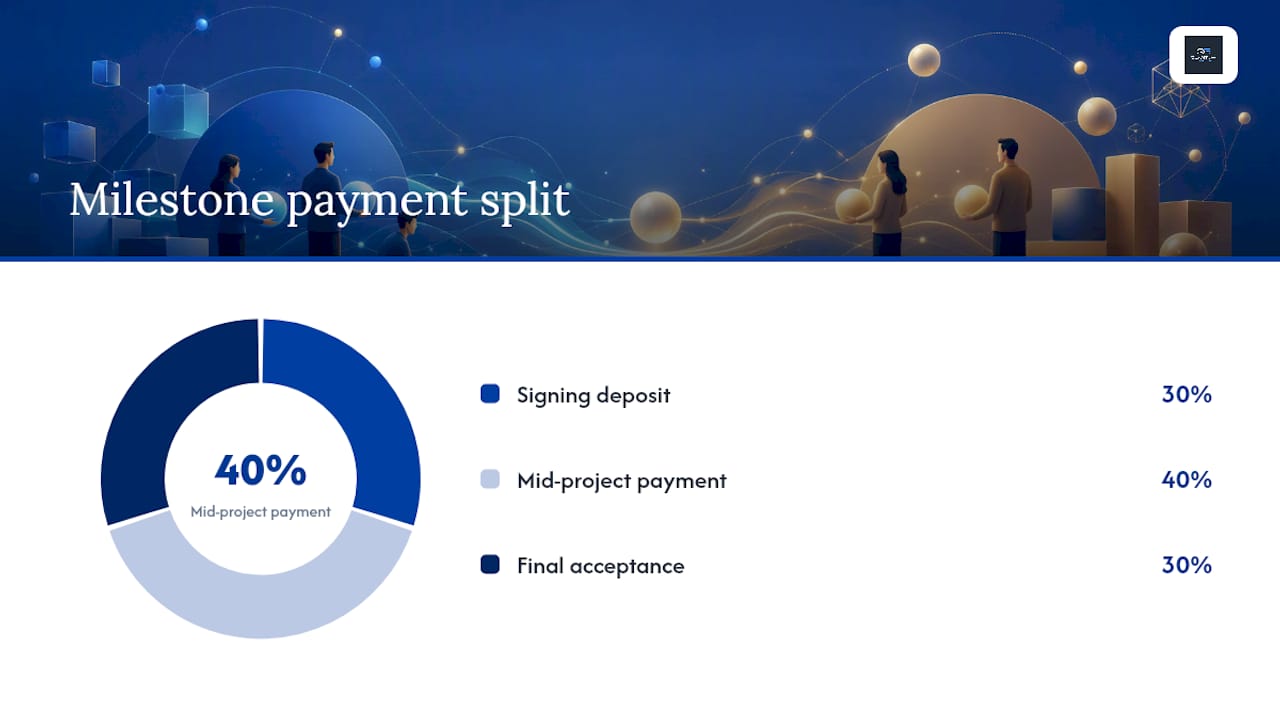
Protecting your margin on project work comes down to four disciplines. First, write acceptance criteria into the contract so “done” is not a moving target. Second, define the number of revision rounds explicitly (two rounds is standard for most creative work). Third, use a change-order process for anything outside the original scope, even small requests. Fourth, bill on milestones rather than on completion: a 30% deposit, 40% at mid-project delivery, and 30% on final acceptance is a common and effective structure.
Projects also serve a strategic purpose that is easy to underestimate. A well-delivered project is the most credible audition for a retainer relationship. Clients who have seen you execute under a fixed scope are far more willing to trust you with ongoing access to their business.
How do retainers and projects compare across key dimensions?
The table below maps both models across the dimensions that matter most to small business owners, freelancers, and agency decision-makers.
| Dimension | Retainer | Project-Based |
|---|---|---|
| Predictability / cash flow | High: fixed MRR, easier forecasting | Low to medium: lumpy, milestone-dependent |
| Scope clarity | Requires active management; creep risk is high | High at signing; change orders protect margin |
| Client relationship depth | Deep over time; institutional knowledge compounds | Transactional; resets with each engagement |
| Pricing structure | Hourly-cap, deliverable-bundle, or dedicated-seat | Fixed-fee, milestone, or time-and-materials |
| Billing cadence | Monthly in advance (MRR) | Deposit + milestones + final invoice |
| Scalability / staffing | Easier to plan; capacity is pre-committed | Harder to staff; peaks and troughs are common |
| Risk profile | Scope creep, underutilization, churn | Scope variance, nonpayment, re-sale pressure |
| Ideal use cases | Ongoing support, SEO, analytics, content, AI maintenance | Site builds, migrations, brand identity, campaign launches |
According to Pitchsite’s agency pricing analysis, successful firms run both models and route work to the appropriate structure rather than forcing every engagement into one shape.
A few non-obvious trade-offs are worth calling out. Retainers reduce your sales time per dollar of revenue, but they increase your relationship management overhead. You need regular check-ins, monthly reports, and proactive communication to keep clients engaged. Projects require more selling effort but less ongoing management once the scope is locked. Neither model is inherently superior; the right choice depends on the client’s needs and your operational capacity.
When you are presenting this comparison to a client or using it in an internal decision memo, lead with the cash flow row. Most small business owners and founders make this decision based on budget predictability, not strategic theory. Once you have aligned on cash flow expectations, the scope and relationship rows usually resolve themselves.
How do you price and bill a retainer vs a project?
Pricing is where most freelancers and small agencies leave money on the table. The math is not complicated, but it requires discipline.
Retainer pricing formulas
Hourly-cost-plus method: multiply your target hourly rate by the number of hours in the retainer, then add a 15–25% buffer for scope variance, communication overhead, and admin. A retainer covering 10 hours per month at a $150 target rate would price at $1,500 plus a 20% buffer, landing at $1,800 per month.
Value-based anchor: price the retainer based on the outcome it delivers, not the hours it consumes. If your monthly SEO work drives $15,000 in attributable pipeline, a $2,000 retainer is priced at roughly 13% of the value created. That framing is far more defensible in a renewal conversation than “10 hours at $150.”
What should go in a retainer or project agreement?
A contract does not prevent disputes. It resolves them quickly when they happen. The clauses below are the ones that matter most.
Change-order process
When a client requests work outside the original scope, respond with a brief written estimate before starting. A simple template:
Pro Tip: Never absorb a change order silently. Even if the extra work takes 30 minutes, logging it and sending a brief note trains clients to respect scope boundaries and prevents the “but I thought that was included” conversation later.
Operational integration
An onboarding checklist for a new retainer client should include: access credentials, brand assets, existing analytics setup, key contacts and approval authority, and a first-month deliverables list. The monthly reporting template should cover hours used, deliverables completed, key metrics moved, and planned focus for the next month.
Red flags to watch for
Avoid a retainer when:
- The client cannot articulate what they need month to month.
- The client is slow to respond or approve work (underutilization risk is high).
- The scope is so broad it could absorb unlimited hours.
Avoid a project when:
- The client makes frequent ad-hoc requests that fall outside any fixed scope.
- The work requires ongoing optimization (SEO, paid media, analytics).
- The client has no internal team to maintain the output after delivery.
Two example decision paths
Early-stage founder launching a new product: The scope is clear (website, landing page, basic analytics setup), the budget is fixed, and the relationship is new. Start with a project. Deliver it well, then propose a monthly support retainer at the close.
Operations-led marketing team: The team runs continuous campaigns, needs weekly analytics reviews, and makes frequent content updates. A deliverable-bundle retainer with a defined monthly package and a 30-day notice clause fits cleanly.
Key Takeaways
Retainers win on cash flow predictability and client lifetime value; projects win on scope clarity and per-engagement margin. The right choice depends on whether the client’s need is ongoing or discrete.
| Point | Details |
|---|---|
| Match model to need type | Ongoing, recurring work belongs in a retainer; discrete, time-bound deliverables belong in a project. |
| Price with a buffer | Add a 15–25% buffer to retainer pricing to cover scope variance, communication overhead, and admin costs. |
| Protect margin with contracts | Include scope inclusions/exclusions, acceptance criteria, a change-order process, and a late-payment clause in every agreement. |
| Use projects as auditions | A well-delivered project is the most credible pathway to a retainer; propose the retainer at project close. |
| Quantum3 serves both models | Quantum3 offers fixed-fee project builds and monthly retainer support for websites, AI integrations, and analytics. |
The case for being deliberate about which model you choose
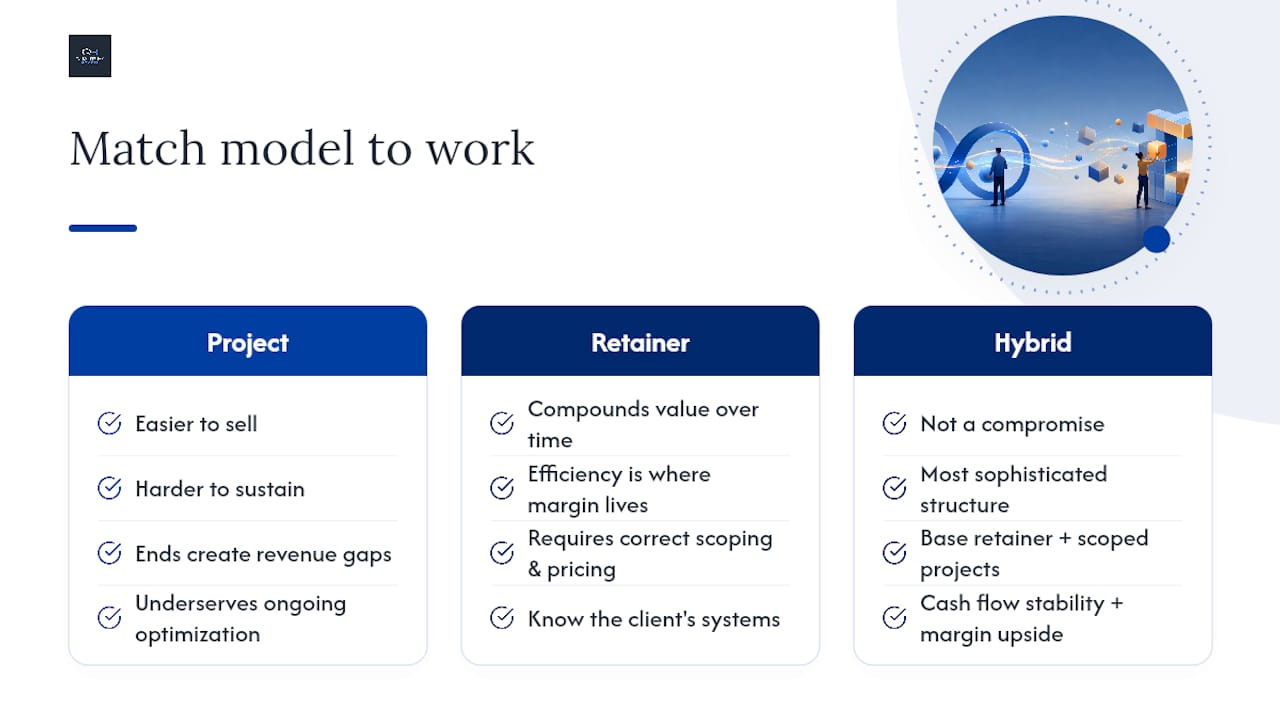
Most of the friction in client relationships comes from a mismatch between the engagement model and the actual nature of the work. A client who needs ongoing optimization locked into a fixed-fee project will always feel underserved. A client who needs a single deliverable on a retainer will always feel like they are overpaying.
The conventional wisdom is to default to projects because they are “safer.” That framing gets it backwards. Projects are easier to sell, but they are harder to sustain. Every project that ends is a revenue gap you have to fill. Retainers, when scoped and priced correctly, compound in value over time: you know the client’s systems, you anticipate their needs, and you deliver more efficiently each month. That efficiency is where your margin actually lives.
The 10-question checklist in this guide is not a formality. It is a tool for having a more honest conversation with a client about what they actually need, not what they think they want. Clients who go through that conversation with you before signing are far less likely to dispute scope, request changes without a change order, or churn after three months.
One more thing worth saying plainly: the hybrid model is not a compromise. It is the most sophisticated structure available to a small agency or freelancer. A base retainer that covers ongoing work, with separately scoped projects for major initiatives, gives you the cash flow stability of a retainer and the margin upside of project pricing. Build toward that structure deliberately, and you will spend far less time worrying about where next month’s revenue is coming from.
How Quantum3 can help you build the right engagement structure
Whether you are ready to launch a high-converting website as a fixed-fee project or you need a monthly partner for AI integrations, analytics, and ongoing digital support, Quantum3 delivers both with transparent pricing and fast execution.
For businesses that need a defined deliverable fast, Quantum3’s website and funnel development services give you a clean project scope, milestone billing, and a finished product built to convert. For businesses that want ongoing digital performance support, Quantum3’s AI integrations and automation services are structured as monthly engagements that compound in value over time. The full range of project and retainer options is available on the Quantum3 services page.
Schedule a discovery call to get a custom proposal, whether that is a fixed-fee project quote or a monthly retainer structure built around your actual needs.
Useful sources and further reading
The sources below support the claims in this article and offer deeper reading on retainer structures, pricing frameworks, and contract language. All are U.S.-focused unless noted.
- Retainer agreement — Cornell Law School Legal Information Institute
- Lawyer retainers — American Bar Association (Law Technology Today)
- Retainer vs Project Pricing for Agencies: The Complete 2026 Guide | Pitchsite
- Improving Profitability: Retainer vs. Project-Based Work — Teamwork.com
- Retainer vs Project Pricing: Decision Framework for Agencies — AgencyPro.app
- Freelance Pricing: Retainers vs Project Fees | 1000incomes.com
- The value of keeping the right customers — Harvard Business Review
This article provides general business and operational information, not legal or financial advice. Retainer and contract rules vary by state and professional category. Consult a qualified attorney before finalizing any client agreement.
Recommended
Want this for your business?
Tell us what you have in mind. A quick conversation is all it takes to scope it out.