Insights
Nylon 12 Printing for Professionals and Advanced Hobbyists
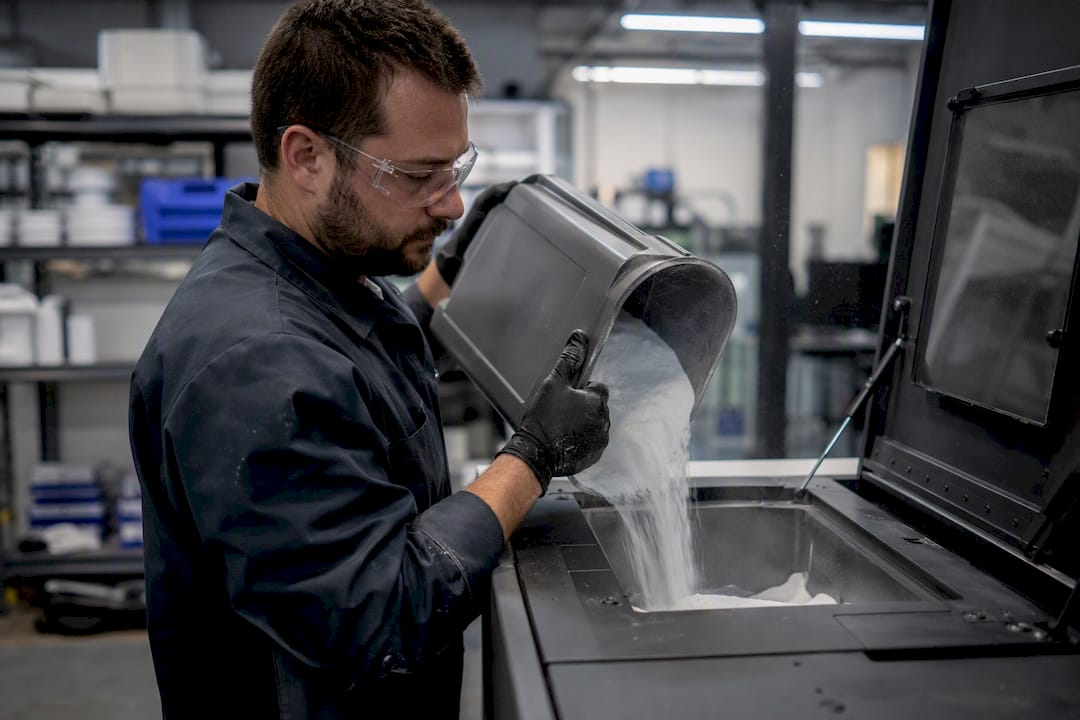
Nylon 12 (PA12) is an engineering thermoplastic prized for durability, chemical resistance, and dimensional stability, and it belongs in production runs, not casual prototypes. Choose SLS or MJF for load-bearing or end-use parts; reserve industrial FDM filaments for machines specifically certified to run them.
-
Functional prototypes that need to survive real handling and stress testing
-
End-use mechanical parts and tooling like jigs, fixtures, and snap-fit housings
A Formlabs Nylon 12 datasheet lists ultimate tensile strength around 50 MPa, which puts it closer to injection-molded nylon than most desktop 3D printing plastics ever get.
Key Takeaways
Nylon 12 delivers near injection-molded mechanical performance through SLS or MJF, provided powder handling, refresh rate, and drying protocols are followed precisely.
| Point | Details |
|---|---|
| Default to powder-bed processes | SLS and MJF remain the standard production methods; industrial FDM is niche and equipment-limited. |
| Control humidity aggressively | Keep handling humidity at or below 50% RH to prevent clumping and surface defects. |
| Follow the 30% refresh rule | Blend roughly 30% fresh powder with reclaimed material per build for consistent results. |
| Match sourcing to your process | Buy validated SLS/MJF powder or certified industrial filament, never mix uncertified material into an unrated printer. |
| Outsource when certification or volume demands it | Quantum3 offers professional PA12 printing services for teams that need production-grade parts without in-house equipment investment. |
Table of Contents
- What Is Nylon 12 and Why Its Properties Matter
- Which 3D Printing Process Actually Runs Nylon 12?
- How Do You Print and Post-Process Nylon 12 Correctly?
- Where Nylon 12 Parts Actually Get Used
- Where to Source Nylon 12 for Your Print
- Fixing the Most Common Nylon 12 Printing Failures
- Should You Print In-House or Use a Print Bureau?
- The Case for Treating PA12 as a Production Material, Not a Novelty
- Get Nylon 12 Parts Printed Right the First Time
- Sources
What Is Nylon 12 and Why Its Properties Matter
Polyamide 12, commonly called Nylon 12 or PA12, is a semi-crystalline thermoplastic built for parts that need to flex, absorb impact, and hold their shape under stress. It’s the same polymer family used in fuel lines and cable sheathing, which tells you something about its chemical tolerance.
The mechanical numbers back that reputation. The same Formlabs datasheet reports a tensile modulus near 1,850 MPa, with elongation at break around 11% in the X/Y plane and 6% along the Z axis. MakerVerse cites similar figures for MJF-processed PA12, with tensile modulus in the 1,700 to 1,800 MPa range and tensile strength near 48 MPa, confirming the two leading processes land in the same performance neighborhood.
Heat deflection temperature matters more than most buyers realize. Formlabs reports HDT values of roughly 87°C at 1.8 MPa and 171°C at 0.45 MPa, meaning the part’s real-world heat tolerance depends heavily on how much load it carries while hot.
- Excellent chemical resistance to oils, fuels, and many solvents
- Low moisture absorption relative to other nylons, though still hygroscopic enough to demand drying
- Strong fatigue resistance, which is why it shows up in snap fits and living hinges
Which 3D Printing Process Actually Runs Nylon 12?
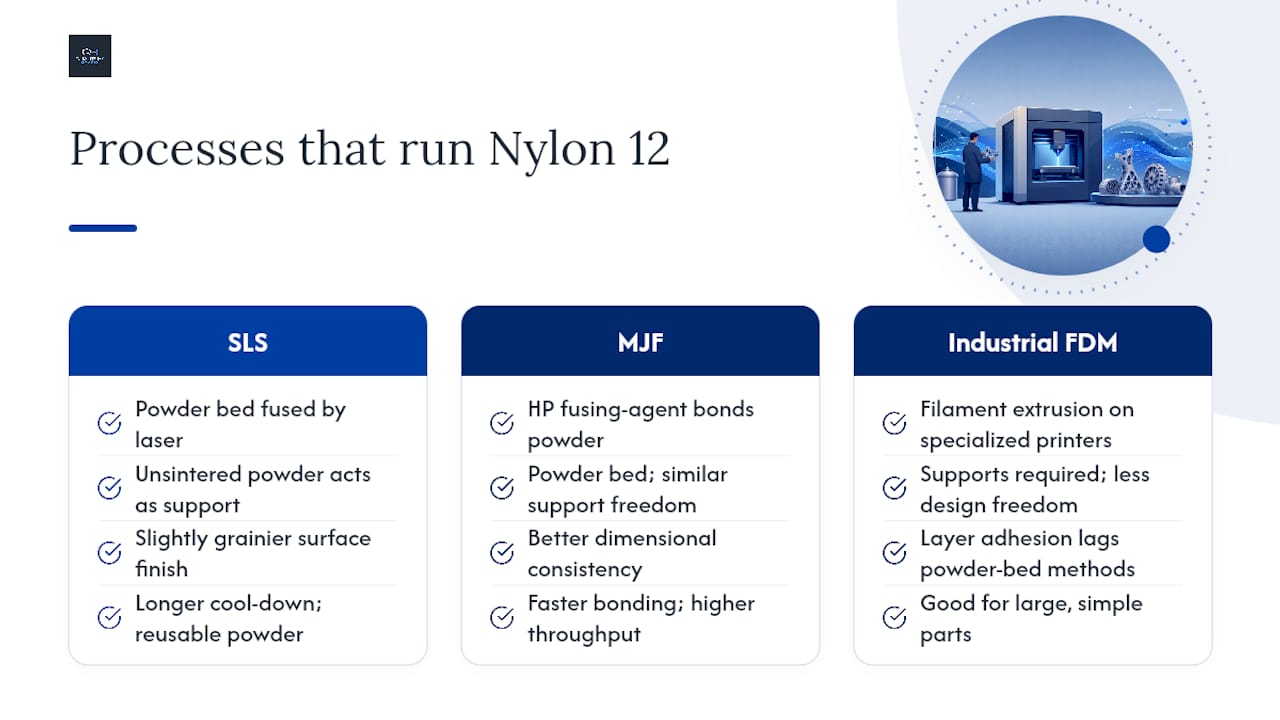
Selective Laser Sintering (SLS) and Multi Jet Fusion (MJF) are the default production methods for Nylon 12 printing. Industrial FDM filaments exist, but they only run on specialized printers built to handle PA12’s processing demands, which keeps that route niche.
SLS builds parts inside a powder bed fused layer by layer with a laser. You get full design freedom, since unsintered powder acts as its own support, and leftover powder can often be reused in the next build. The tradeoff is a slightly grainier surface finish and longer cool-down cycles before parts can be removed.
MJF uses HP’s fusing-agent process to bond powder faster than SLS, with better dimensional consistency across a packed build chamber. Throughput is the main draw, particularly for batches of similar parts, though machine access is more concentrated among a handful of service providers.
Industrial FDM with PA12-specific filament can work for larger, less geometrically complex parts, but layer adhesion tends to lag behind powder-bed methods, and few desktop machines are rated for the temperatures involved.
Pro Tip: If your build volume exceeds what a single in-house SLS unit handles comfortably, a certified FDM Nylon 12 filament partner can fill the gap without forcing a full MJF investment.
For one-off parts or infrequent runs, a service bureau usually beats buying equipment. For recurring production with certification requirements, in-house SLS or MJF pays off faster.
How Do You Print and Post-Process Nylon 12 Correctly?
Drying isn’t optional with PA12. Keep handling humidity at or below 50% relative humidity, because moisture absorbed into the powder or filament causes surface pitting and weak layer bonds almost every time.
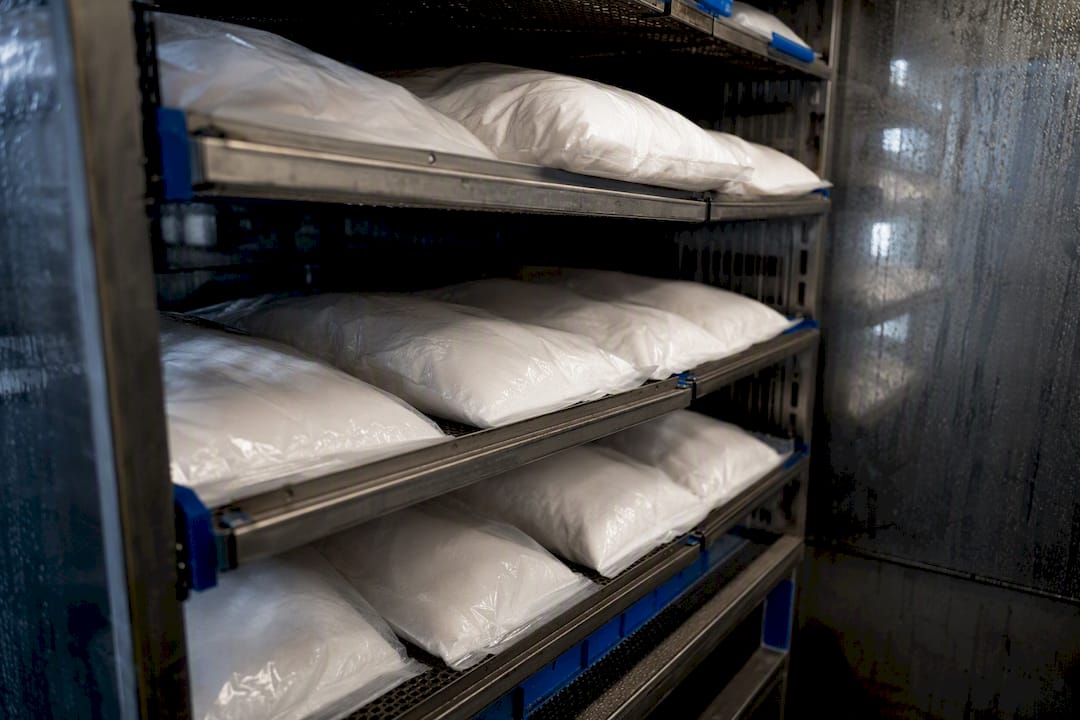
Formlabs recommends a powder refresh rate of about 30%, meaning roughly a third of each build’s powder should be fresh material blended with reclaimed powder from prior runs. EOS documents a comparable 30% refresh rate for some PA 2200 family formulations, which suggests this ratio is close to an industry norm rather than a single vendor’s quirk.
| Parameter | Typical Range | Notes |
|---|---|---|
| Powder refresh rate | ~30% | Blend fresh with reclaimed powder per build |
| Handling humidity | ≤50% RH | Higher humidity causes clumping and surface defects |
| HDT @ 1.8 MPa | ~87°C | From Formlabs datasheet |
| HDT @ 0.45 MPa | ~171°C | From Formlabs datasheet |
| Tensile strength | ~48-50 MPa | Consistent across SLS and MJF sources |
Post-processing typically follows this order: de-powdering with compressed air or a dedicated recovery station, bead blasting or tumbling for surface finish, optional dyeing for color, and annealing when a part needs extra thermal stability. Formlabs also advises swapping build components when switching from lower-temperature powders to a dedicated PA12 chamber, since residual heat differences can warp early builds.
- De-powder immediately after cool-down to prevent powder caking in fine features
- Tumble or bead-blast for a consistent matte finish before dyeing
- Anneal parts destined for sustained heat exposure above their working HDT
Pro Tip: On your first run with aged or refreshed powder, dedicate a small calibration print to bed-temperature tuning before committing to a full production batch.
Where Nylon 12 Parts Actually Get Used
Automotive shops use PA12 for brackets, ducting, and under-hood components that need chemical resistance against oils and fuels. Aerospace teams lean on it for lightweight housings and ducting where fatigue resistance under vibration matters more than raw stiffness.
- Jigs and fixtures: PA12’s dimensional stability keeps tooling accurate across repeated use
- Medical devices: biocompatible PA12 variants exist, but certification requirements mean you verify the exact grade before specifying it for patient contact
- Consumer goods: snap-fit enclosures and housings benefit from PA12’s elongation at break
- Oil and gas: seals and fittings take advantage of chemical resistance to hydrocarbons
Functional prototypes remain the most common entry point. Once a design proves out mechanically, the same PA12 file often becomes the end-use part with no material change required.
Where to Source Nylon 12 for Your Print
Buy powder from validated vendors when running SLS or MJF, and only buy industrial PA12 filament for printers explicitly certified to process it. Mixing an uncertified filament into a machine not rated for PA12’s melt temperature is a common way to damage hot ends.
A working buying checklist: material form (powder versus filament), grade (general-purpose versus glass- or carbon-filled), particle size and purity, the vendor’s stated refresh rate, and whether a full datasheet and certification package ships with the order.
Several named products anchor the current market. Formlabs Nylon 12 Powder is a widely referenced SLS material with a public datasheet detailing its mechanical and thermal values. Stratasys FDM Nylon 12 represents the industrial filament route for Stratasys-certified FDM systems. EOS PA2200, part of the PA12 multipurpose family, has a long track record across automotive and medical applications. HP Nylon 12 is the material HP’s Jet Fusion platform is built around, optimized specifically for MJF’s fusing-agent process.
Sinterit notes that industrial-grade PA12 powders typically cost between $70 and $150 per kilogram, with purity and formulation driving most of that spread. Always request a current datasheet and ask directly about recommended reuse ratios before ordering in bulk.
Fixing the Most Common Nylon 12 Printing Failures
Moisture and incorrect chamber temperatures cause most PA12 print failures. Run through these checks before assuming a machine problem.
- Warping: usually a chamber or bed temperature mismatch. Recalibrate temperature settings and confirm the powder was dried per manufacturer specs.
- Poor layer fusion: often insufficient laser energy or fusing agent coverage. Check machine calibration and confirm powder refresh rate hasn’t drifted below recommended levels.
- Powder clumping: almost always humidity exposure. Store powder sealed and verify handling environments stay at or below 50% RH.
- Surface defects: frequently tied to using overly aged powder without proper refresh blending. Increase the fresh-powder ratio and retest.
- Dimensional inaccuracy: check for chamber temperature drift across the build and confirm the machine’s calibration schedule is current.
- Run a documented drying cycle before every build, not just when parts fail
- Tune bed temperature specifically for refreshed or aged powder batches
- Increase refresh rate incrementally rather than guessing at a fixed ratio
Should You Print In-House or Use a Print Bureau?
Choose in-house printing when you control validated equipment, run frequent volume, and need to manage your own certification documentation. Choose a bureau for one-off parts, new-design qualification runs, or when your facility lacks proper powder-handling infrastructure.
Run this checklist before deciding: expected volume, part certification requirements, build size versus your available chamber, post-processing capacity on site, operator safety protocols for powder handling, and cost per part at your actual run rate.
A dependable in-house PA12 workflow looks like this:
- Inspect incoming material against its datasheet
- Apply your aging and refresh protocol before loading the build
- Tune bed temperature using the refreshed powder blend
- Run the build with a documented profile
- De-powder and recover unused material for the next refresh cycle
- Post-process (blast, dye, or anneal as required)
- Perform quality control and document results for traceability
- Bureaus win on flexibility and zero equipment overhead
- In-house wins on cost per part once volume climbs and certification stays internal
The Case for Treating PA12 as a Production Material, Not a Novelty
Most guides to Nylon 12 printing still talk about it like a prototyping curiosity, and that framing undersells what the material actually does. PA12 isn’t a stepping stone to “real” manufacturing. For a huge range of mechanical parts, it is the real manufacturing process, and treating it otherwise leads teams to over-engineer designs for injection molding they’ll never actually run.
The bigger gap I see is in how casually people treat powder handling. Refresh rate and humidity control get mentioned as footnotes in most tutorials, but vendor guidance consistently flags these two variables as the highest-impact factors for both reliability and cost per part. Skip the drying step once, and you’ll spend more time troubleshooting warped parts than you saved by rushing the build.
The in-house-versus-bureau decision also gets oversimplified. It’s not about which option is cheaper in isolation. It’s about whether your team can maintain a validated powder-handling process consistently, batch after batch. If you can’t commit to that discipline, a bureau isn’t a fallback, it’s the smarter engineering decision.
Get Nylon 12 Parts Printed Right the First Time
If you’ve read this far, you already know that Nylon 12 printing rewards precision and punishes shortcuts on drying, refresh rates, and bed calibration. Quantum3 runs professional 3D printing services built around exactly that discipline, handling custom and engineering-grade PA12 parts without you needing to own or validate the equipment yourself.

That matters most if you’re weighing an equipment purchase against outsourcing a handful of production runs. Quantum3 manages material inspection, refresh protocols, and post-processing so your parts come back consistent, without the learning curve of managing powder handling internally. The team also supports broader technical needs through AI-driven integrations if your project involves connecting print production to inventory or ordering systems.
Check current capabilities and part specifications on the 3D printing services page, or submit your project details through Quantum3’s enquiries form to get a quote on your next PA12 run.
Sources
- Using Nylon 12 | Formlabs
- Nylon 12 SLS Powder – Properties, Applications, Price – Sinterit Inc.
- Polyamide 12 (PA 12) Powders for 3D Printing | EOS GmbH
Recommended
Want this for your business?
Tell us what you have in mind. A quick conversation is all it takes to scope it out.