Insights
Heat-Resistant 3D Printing: Best Materials by Temperature
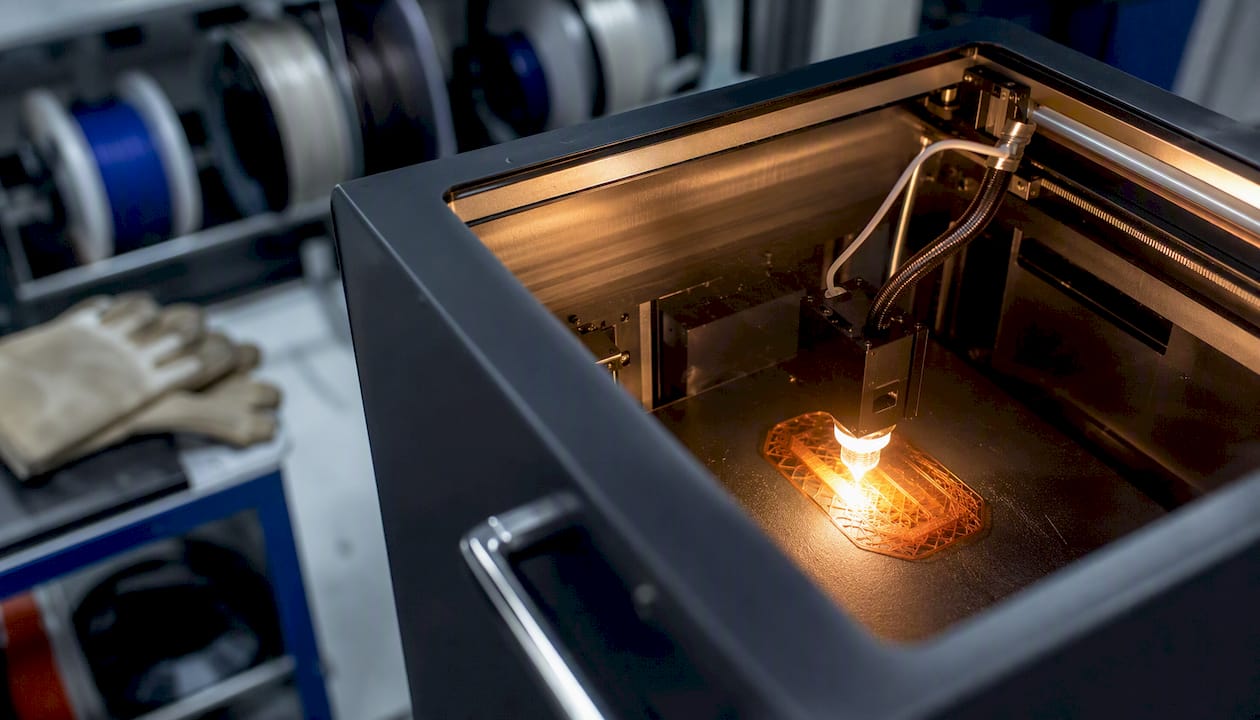
For moderate heat up to around 80°C, PETG is the practical default — it prints in open air, needs no enclosure, and handles most functional parts without drama. Step up to ABS or ASA when you need a Tg near 100°C and can tolerate the enclosure and ventilation requirements. For continuous service above 120°C, polycarbonate (PC) and high-temp nylons are the next tier. Above 150°C and under sustained load, only engineering-grade thermoplastics — PEEK, PEI/Ultem, PPSU, or PSU — reliably hold their geometry. The single biggest mistake makers make is choosing a material by its Tg alone; HDT under realistic load and creep behavior over time are what actually determine whether a part survives in service.
Here is the practical shortlist:
- Up to 80°C (outdoor enclosures, brackets, light-duty clips): PETG — easy to print, widely available, low cost
- 80–110°C (automotive interior trim, appliance housings): ABS or ASA — higher heat tolerance, requires enclosure and ventilation
- 110–150°C (tooling, electrical housings, under-hood clips): PC or PA12/PA6 high-temp nylon — strong and stiff, needs enclosure and hardened nozzle
- 150°C and above (engine-bay components, aerospace brackets, medical tooling): PEEK, PEI/Ultem, PPSU — industrial printers required, high cost, exceptional performance
Key Takeaways
For heat-resistant 3D printing, the right material is determined by HDT under load and creep behavior — not Tg alone — and the hardware requirements escalate sharply above 150°C continuous service.
| Point | Details |
|---|---|
| Match material to service temp | PETG to ~75°C, ABS/ASA to ~100°C, PC/nylon to ~130°C, PEEK/PEI above 150°C continuous service. |
| Use HDT under load, not Tg | For loaded parts, use HDT at 1.82 MPa minus a 10–20% safety margin as your design ceiling. |
| Hardware scales with temperature | PC and above require an enclosure, PEI and PEEK require an industrial heated chamber and 400°C hotend. |
| Dry hygroscopic filaments | Nylon and PEEK must be dried before printing; moisture causes weak bonds and surface defects at high extrusion temps. |
| Quantum3 for industrial-grade parts | Quantum3’s 3D printing service covers PEEK, PEI, SLS nylon, and high-temp SLA with material consultation and post-processing included. |
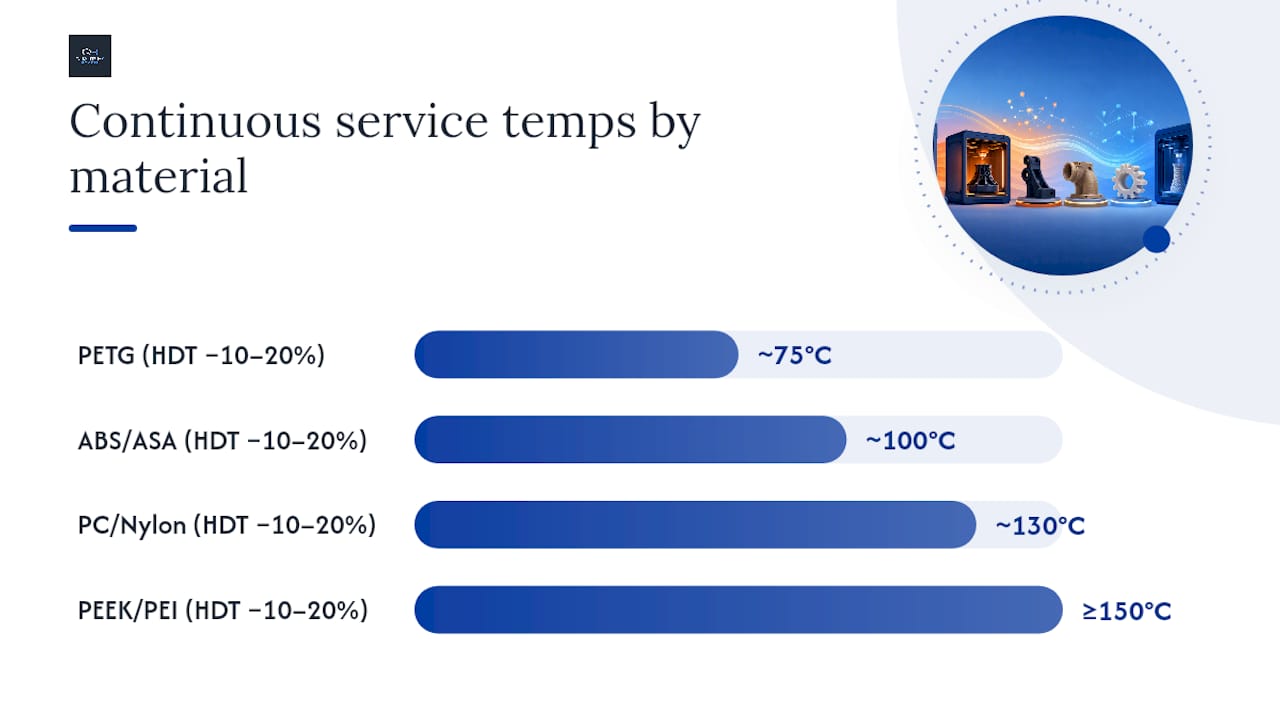
Table of Contents
- How do heat-resistant 3D printing materials compare at a glance?
- How is heat resistance actually measured?
- Which FDM filaments handle high temperatures reliably?
- When do SLA resins and SLS powders outperform FDM?
- What hardware do you need for high-temperature 3D printing?
- Post-processing steps that improve heat performance
- How do you choose the right heat-resistant material for your application?
- Safety, fumes, and handling for high-temperature materials
- Creep, thermal aging, and setting real safety margins
- What the conventional advice on heat-resistant printing gets wrong
- Quantum3 can handle your high-temperature 3D printing projects
- Sources
How do heat-resistant 3D printing materials compare at a glance?
The table below covers the most common material families, from the familiar to the industrial. Service temperature figures reflect continuous use under moderate load; peak or short-term tolerance is typically 10–20°C higher.
| Material | Typical service temp / HDT | Print difficulty | Nozzle / Bed temp | Warping risk | Best for | Relative cost |
|---|---|---|---|---|---|---|
| PLA | 55–60°C (Tg ~55–60°C) | Easy, open air | 190–220°C / 60°C | Low | Prototypes only | Low |
| PETG | ~80°C (Tg ~80°C) | Easy, open air | 230–250°C / 70°C | Low | Functional parts, enclosures, brackets | Low–Medium |
| ABS | ~95–100°C (HDT ~96°C @0.45 MPa) | Moderate, enclosure needed | 230–250°C / 100–110°C | High | Interior trim, housings, acetone-smoothed parts | Low–Medium |
| ASA | ~95–100°C | Moderate, enclosure recommended | 240–260°C / 90–110°C | Moderate | Outdoor UV-exposed parts, automotive exterior | Medium |
| PC (Polycarbonate) | ~110–138°C (HDT ~110–138°C) | Difficult, enclosure required | 260–310°C / 110–120°C | High | Electrical housings, tooling, load-bearing parts | Medium |
| PA6 / PA12 (Nylon) | ~100–120°C (HDT varies by grade) | Moderate–Difficult, enclosure helps | 240–280°C / 70–90°C | Moderate | Gears, snap-fits, under-hood clips | Medium |
| PEI / Ultem | ~150–170°C continuous | Difficult, heated chamber required | 350–380°C / 140–160°C | High | Aerospace, medical, high-load structural | High |
| PEEK / PEKK | ~230–260°C (HDT up to ~260°C) | Very difficult, industrial printer | 360–400°C / 120–160°C | High | Engine-bay, tooling, structural aerospace | Very High |
| PPSU / PSU | ~150–180°C | Difficult, heated chamber required | 340–380°C / 140–160°C | High | Fluid systems, sterilizable medical parts | High |
Quick scenario guide:
- Outdoor enclosures and light brackets: PETG is the right call — no enclosure, low cost, prints reliably
- Engine-bay clips and interior trim: ABS or ASA with a proper enclosure; ASA if UV exposure is a factor
- Electrical housings and tooling jigs: PC or high-temp PA12 — stiffer and more heat-stable under load
- Continuous high-heat structural parts: Send to a service bureau for PEEK or PEI/Ultem printing
How is heat resistance actually measured?
Knowing the number on a datasheet is only useful if you know what that number measures. Three metrics dominate material datasheets, and they are not interchangeable.
Glass transition temperature (Tg) is the point at which an amorphous polymer transitions from a rigid, glassy state to a softer, rubbery one. Below Tg, the material holds its shape under light loads. Above it, stiffness drops sharply. For PLA, that threshold sits at roughly 55–60°C — which is why a PLA part left on a car dashboard warps on a summer afternoon. PETG’s Tg lands near 80°C, and ABS near 100°C.
Heat deflection temperature (HDT) measures how much a loaded beam deflects under a specified stress at increasing temperatures. The two standard loads are 0.45 MPa (66 psi) and 1.82 MPa (264 psi). HDT at 0.45 MPa is the more commonly cited figure and is less conservative; HDT at 1.82 MPa is the number to use for parts that carry real structural loads. For a loaded bracket, HDT under realistic load is the right metric, not Tg alone.
Vicat softening point measures the temperature at which a needle penetrates a polymer surface under a defined load. It is useful for semi-crystalline polymers where HDT can be misleading, but for most FDM design decisions, HDT remains the primary reference.
Service temperature and creep are the numbers that matter most in practice. Service temperature is the manufacturer’s recommended continuous-use ceiling, typically set below both Tg and HDT with a built-in safety margin. Creep is the slow, permanent deformation a part undergoes under sustained load at elevated temperature — and it can cause failure well below Tg. A part clamped under constant stress at 70°C in a PETG material rated to 80°C Tg will deform over weeks or months.
- Tg: use for initial material screening and understanding softening behavior
- HDT @0.45 MPa: use for lightly loaded or intermittently heated parts
- HDT @1.82 MPa: use for structurally loaded parts; this is the conservative engineering number
- Service temperature: the manufacturer’s ceiling, already safety-margined
- Creep data: required for any part under sustained load near its thermal limit
That margin accounts for creep, layer-line anisotropy, and real-world temperature spikes.*
Which FDM filaments handle high temperatures reliably?
FDM covers the widest range of heat-resistant options, from hobbyist-accessible PETG all the way to aerospace-grade PEEK. Each material family has a distinct thermal and mechanical personality.
PETG
PETG (polyethylene terephthalate glycol) is the workhorse of functional printing. Its Tg near 80°C makes it suitable for most indoor functional parts, and it prints reliably in open air at 230–250°C without an enclosure. Warping is minimal, bed adhesion is forgiving, and it costs roughly the same as PLA. The ceiling is real, though: anything that will see sustained temperatures above 70°C under load should move to a higher-tier material.
ABS and ASA
ABS offers higher heat tolerance with a Tg near 100 °C and an HDT around 96 °C at 0.45 MPa. It also supports acetone vapor smoothing, which produces near-injection-molded surface quality. The trade-offs are real: ABS requires an enclosure to prevent warping, and it emits styrene during printing, making strong ventilation non-negotiable. ASA is the outdoor-capable sibling — similar thermal performance but with significantly better UV resistance, making it the right call for any part that lives outside. Both materials print at 230–260°C nozzle and 100–110°C bed.
Polycarbonate (PC)
PC is one of the most underused materials in the hobbyist space. HDT values commonly reach 110–138°C, and it is genuinely tough — impact resistance is among the highest of any printable thermoplastic. The challenge is printability: PC needs nozzle temps of 260–310°C, a heated bed at 110–120°C, and a well-sealed enclosure to prevent warping and delamination. A hardened steel nozzle is recommended because PC is abrasive at high temperatures. For electrical housings, tooling jigs, and load-bearing brackets that need to survive a hot environment, PC is often the most cost-effective engineering choice before jumping to industrial polymers.
High-temperature nylons (PA6, PA12, PA6-CF, PA12-CF)
Nylon’s thermal performance varies dramatically by grade and fill. Unfilled PA12 has an HDT that can be modest, but carbon-fiber-filled PA12 and PA6 grades push HDT well above 150°C in some formulations. Taulman is a well-known supplier for nylon filaments, offering grades from standard PA12 to reinforced blends suited to functional engineering parts. Nylon is hygroscopic — it absorbs moisture from the air aggressively — so drying before printing is not optional. Print at 240–280°C nozzle, 70–90°C bed, and use an enclosure to manage warping on larger parts.
PEI / Ultem
Polyetherimide (PEI), sold under the Ultem brand name, is where the process moves firmly into industrial territory. Continuous-use temperatures above 150°C are standard, and Ultem 9085 and 1010 grades are certified for aerospace and medical applications. Nozzle temperatures of 350–380°C and a heated chamber at 140–160°C are required. 3DXTech and Essentium both supply PEI/Ultem filaments for industrial FDM systems. The cost is high, the hardware requirements are demanding, and the reward is a part that holds its geometry in environments that would destroy PC or nylon.
PEEK and PEKK
PEEK (polyether ether ketone) sits at the top of the printable thermoplastic hierarchy. PEEK is commonly used up to approximately 250°C, with some formulations reaching HDT values near 260°C. Printing requires a hotend capable of 360–400°C, a heated chamber, and careful filament drying. 3DXTech supplies PEEK and PEKK filaments for high-end FDM systems, and Essentium offers engineering-grade PEEK formulations for industrial platforms. PEKK is slightly easier to print than PEEK and offers comparable thermal performance with better layer adhesion in some configurations.
The practical dividing line in high-temperature FDM is 150°C continuous service. Below it, PC and high-temp nylons cover most applications on a well-equipped desktop machine. Above it, you are in PEI/Ultem and PEEK territory — and that means industrial hardware, careful filament handling, and a significant cost step up. Choosing PEEK for a part that only needs to survive 120°C is not just expensive; it introduces print complexity that increases failure risk without adding meaningful performance.
PPSU and PSU
Polyphenylsulfone (PPSU) and polysulfone (PSU) fill the gap between PC and PEEK. Continuous service temperatures of 150–180°C, excellent chemical resistance, and the ability to withstand repeated steam sterilization make them the preferred choice for medical device components and fluid-handling parts. Both require heated chambers and nozzle temps in the 340–380°C range. Availability is more limited than PEEK, but 3DXTech and similar industrial filament suppliers carry both grades.
When do SLA resins and SLS powders outperform FDM?
FDM is not always the right process for heat-critical parts. Two alternatives — stereolithography (SLA) and selective laser sintering (SLS) — offer distinct advantages in specific scenarios.
High-temperature SLA resins
Formlabs has pushed SLA into engineering territory with resins designed specifically for thermal performance. Formlabs High Temp Resin reports an HDT of 238°C at 0.45 MPa, and Rigid 10K Resin offers comparable stiffness with strong thermal stability. SLA parts have isotropic mechanical properties (no layer-line weakness), exceptional surface finish, and fine feature resolution — making them ideal for mold masters, microfluidic devices, and enclosures where dimensional accuracy matters as much as heat resistance. The limitation is brittleness: high-temp SLA resins tend to be stiffer and more brittle than engineering thermoplastics, so they are not the right choice for impact-loaded parts.
SLS nylon powders
SLS produces parts without support structures, which means complex geometries that would be impossible or impractical in FDM are straightforward. SLS nylon powders — Nylon 11, Nylon 12, and glass or carbon-filled variants — deliver HDT values commonly in the 170–190°C range at 0.45 MPa for high-performance grades. The parts are dense, durable, and handle elevated temperatures well. SLS hardware is industrial-scale and expensive, so most makers access it through a service bureau rather than in-house.
When to choose SLA or SLS over FDM:
- SLA: when surface finish, dimensional accuracy, or mold-master quality is the priority and the part is not impact-loaded
- SLS: when geometry is complex, support structures would be impractical, and you need both heat resistance and mechanical durability
- FDM: when you need the widest material range, the lowest per-part cost, and can accept anisotropic layer properties
What hardware do you need for high-temperature 3D printing?
The material is only half the equation. Without the right hardware, even a correctly chosen filament will fail to print reliably.
Non-negotiable hardware for heat-resistant filaments:
- High-temp hotend: Standard PTFE-lined hotends are limited to around 240°C before the PTFE liner degrades. For PC and above, you need an all-metal hotend. For PEEK and PEI, a hotend rated to 400°C is required.
- Hardened steel nozzle: Brass nozzles wear quickly with abrasive carbon-fiber or glass-fiber-filled materials. Hardened steel or ruby-tipped nozzles are the standard for any reinforced filament.
- Heated bed: PC needs 110–120°C; PEI and PEEK need 140–160°C. A standard 60°C bed is insufficient for anything above ABS.
- Enclosure or heated chamber: ABS needs a passive enclosure to prevent warping. PC, PEI, PEEK, and PPSU need an actively heated chamber — typically 60–120°C ambient — to prevent delamination and residual stress cracking.
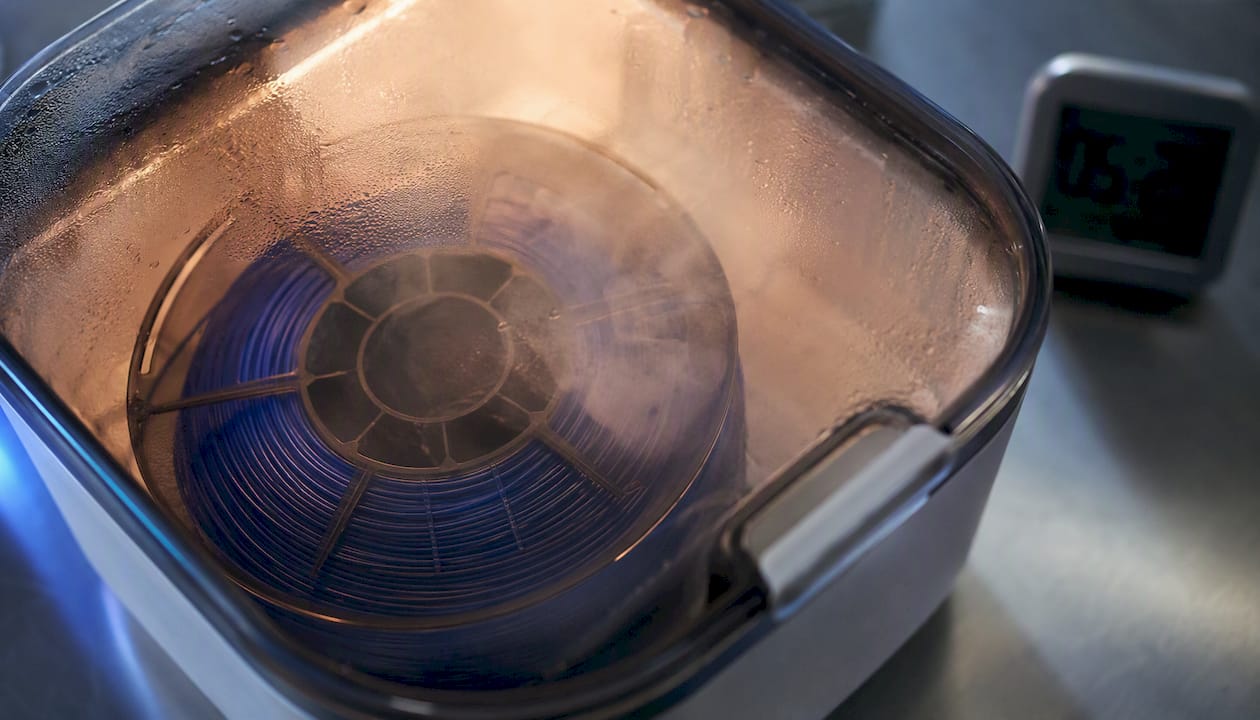
- Filament dryer: Nylon and PEEK are hygroscopic and must be dried before printing. A dedicated filament dryer (PrintDry, eSUN eBOX, or similar) set to the material’s recommended drying temperature is essential. Printing wet nylon produces bubbling, stringing, and weak layer bonds.
- Adhesion surface: PEI build plates work well for PETG and PC. Garolite (G10) is the preferred surface for nylon. High-temp materials like PEEK often require specialized build surfaces or release agents.
Core slicer settings for heat-resistant materials:
- Nozzle temperature: follow the material supplier’s recommended range; start at the midpoint and adjust for layer adhesion
- Bed temperature: match to material (see table above); use a brim or raft for high-warp materials
- Print speed: slower speeds (20–40 mm/s) improve layer adhesion for engineering materials; PEEK especially benefits from slow, deliberate passes
- Cooling: most engineering materials print better with minimal or zero part cooling; active cooling can cause delamination in PC and above
- Perimeters: 4–6 perimeters rather than high infill percentages for heat-resistant structural parts — perimeters carry load more effectively than infill at elevated temperatures
- Annealing: post-print annealing in an oven at 10–20°C below Tg for 1–4 hours relieves residual stress and can increase effective HDT by 10–20°C in semi-crystalline materials like nylon and PEEK
Pro Tip: Before loading an expensive engineering filament, run this quick checklist: (1) Can your hotend reach the required nozzle temp? (2) Do you have a hardened nozzle? (3) Is your bed capable of the required temperature? (4) Do you have an enclosure or heated chamber? (5) Is your filament dry? If you cannot check all five, the print will likely fail — and the cost of wasted PEEK or PEI filament makes that a painful lesson. When in doubt, send the job to a professional print service.
Post-processing steps that improve heat performance
Printing is not always the last step. Several post-processing techniques can meaningfully increase a part’s effective service temperature or surface quality.
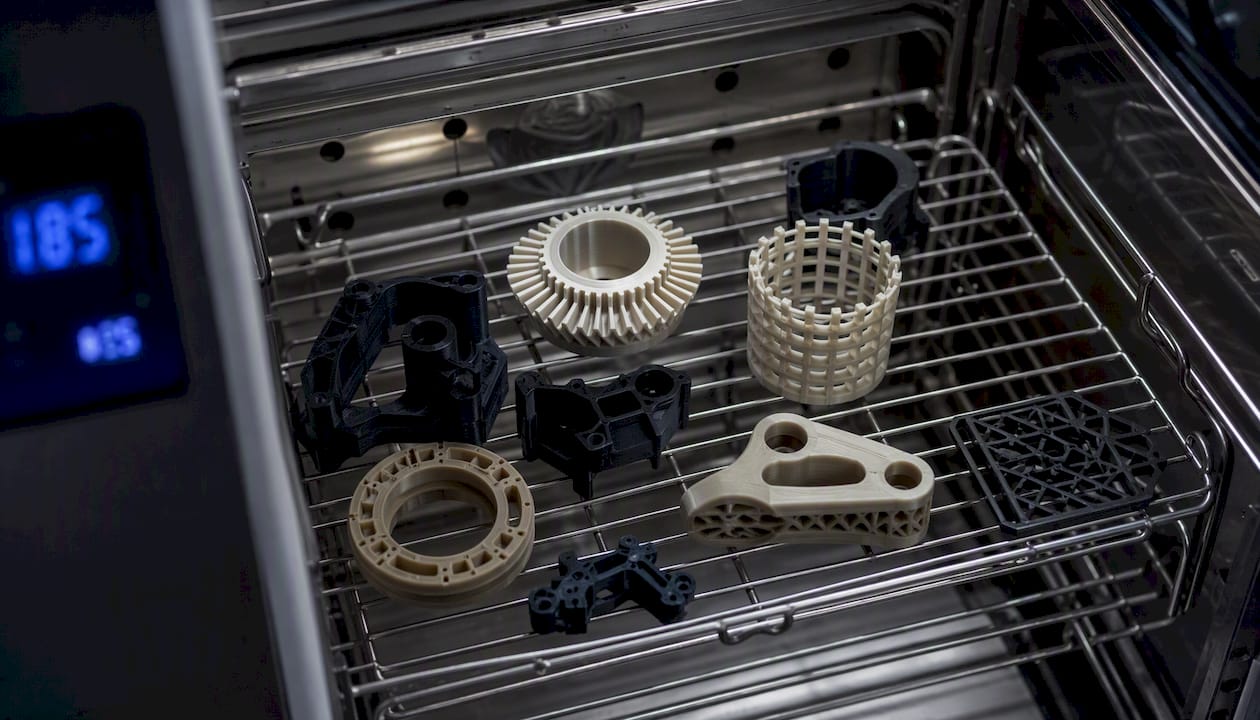
Annealing is the most impactful post-processing step for heat resistance. Heating a printed part to just below its Tg in a controlled oven allows residual stresses from the printing process to relax and, in semi-crystalline polymers like nylon and PEEK, increases the degree of crystallinity. Higher crystallinity raises both stiffness and HDT. A typical protocol for nylon: 80–90°C for 2–4 hours, supported in sand or vermiculite to prevent sagging. For PEEK: 150–200°C for 1–2 hours. The caveat is dimensional change — annealing can cause slight warping or shrinkage, so anneal before final machining or assembly, not after.
Acetone vapor smoothing works only on ABS and ASA. It dissolves the outer surface layer, fusing layer lines and producing a near-injection-molded finish. Beyond aesthetics, the smoothed surface has slightly improved moisture resistance. It does not meaningfully raise HDT, but it does reduce stress concentration points at layer interfaces, which can improve fatigue life at elevated temperatures.
High-temperature coatings and paints can provide a thermal barrier or UV protection on the surface without changing the bulk polymer’s thermal properties. Ceramic-loaded spray coatings (such as those used in automotive applications) can protect a surface from brief radiant heat exposure, but they do not raise the part’s structural service temperature.
Machining and secondary operations are practical with PEEK and PEI parts. Both machine cleanly with standard carbide tooling, allowing tight tolerances and threaded inserts that would be difficult to achieve in print alone. This makes them genuinely viable for precision engineering applications where a printed-and-machined hybrid approach delivers the best result.
How do you choose the right heat-resistant material for your application?
Work through this checklist before committing to a material or printer setup.
- Define the maximum continuous temperature. What is the highest temperature the part will experience for hours or days at a time? This is your primary filter.
- Define peak or short-term temperature spikes. A part near an engine may see 150°C for seconds during a heat soak. Your material’s peak tolerance must cover this, not just the continuous rating.
- Define the load profile. Is the part clamped, compressed, or carrying a bending load? If yes, use HDT at 1.82 MPa as your reference, not Tg. An unloaded cover can tolerate temperatures closer to Tg; a loaded bracket cannot.
- Define environmental exposures. UV, moisture, fuels, solvents, and cleaning agents all degrade polymers. ASA handles UV better than ABS; PPSU handles steam sterilization; PEEK resists most chemicals.
- Set a safety margin. For continuous loaded service, target a material whose HDT at 1.82 MPa is at least 20–30°C above your maximum continuous temperature.
- Assess printer access and cost. Can you print this material on your current machine, or does it require industrial hardware? Factor in filament cost, print failure risk, and whether a service bureau is more practical.
Red flags that should push you to a higher-grade material or a service bureau:
- Continuous service temperature within 15°C of the material’s Tg
- Repeated thermal cycling (heating and cooling repeatedly accelerates fatigue and creep)
- Unknown or aggressive chemical exposure
- Structural load combined with elevated temperature
- Part failure would create a safety hazard
Performance vs. cost vs. print difficulty (short summary):
- PETG: high printability, low cost, moderate heat resistance
- ABS/ASA: moderate printability, low cost, good heat resistance with enclosure
- PC: lower printability, medium cost, strong heat and impact resistance
- High-temp nylon: moderate printability (with drying), medium cost, good heat and chemical resistance
- PEI/Ultem: low printability (industrial only), high cost, excellent heat and mechanical performance
- PEEK/PEKK: very low printability (industrial only), very high cost, top-tier thermal and mechanical performance
Safety, fumes, and handling for high-temperature materials
Heat-resistant printing often means higher nozzle temperatures, more aggressive materials, and more hazardous emissions. Treat ventilation as a hardware requirement, not an afterthought.
Emissions by material:
- PLA: relatively low emissions; some VOCs and ultrafine particles (UFPs), but among the safest FDM materials
- PETG: moderate UFP emissions; print in a ventilated space
- ABS: emits styrene, a known irritant and suspected carcinogen; requires strong ventilation and an enclosure that vents outside or through a HEPA/activated-carbon filter
- ASA: similar to ABS; styrene emissions present
- PC: elevated temperatures produce more UFPs; ventilate well
- Nylon: emits caprolactam and other amines; ventilate and avoid prolonged exposure
- PEEK/PEI: high-temp printing produces complex VOC mixtures; industrial ventilation or local exhaust ventilation (LEV) is the standard
Practical ventilation strategies:
- For hobby printers: enclose the printer and duct exhaust through an activated-carbon filter or outside
- For ABS and ASA: never print in an unventilated room; a window fan drawing air out is the minimum
- For industrial materials (PEEK, PEI, PPSU): local exhaust ventilation at the print head level, or a dedicated ventilated enclosure with filtered exhaust
PPE and handling:
- Wear nitrile gloves when handling solvent baths (acetone for ABS smoothing)
- Use an N95 or P100 respirator when sanding any printed part — all polymer dusts carry inhalation risk
- Dispose of acetone and solvent baths as chemical waste per local regulations
Storage and drying:
- Store nylon, PEEK, PEI, and PPSU filaments in sealed containers with desiccant between uses
- Dry nylon at 70–80°C for 4–8 hours before printing; PEEK at 120–150°C for 4–6 hours
- Wet filament produces bubbling, stringing, and weak layer bonds — and at PEEK printing temperatures, moisture-induced degradation can permanently damage the polymer
Creep, thermal aging, and setting real safety margins
The datasheet gives you a number. Engineering judgment tells you how much of that number you can actually use.
Creep is the slow, permanent deformation that occurs when a polymer is held under sustained stress at elevated temperature. It happens below Tg, below HDT, and below the manufacturer’s stated service temperature. The rate depends on three variables: temperature, stress magnitude, and time. A PETG bracket clamped at 65°C under moderate load may hold its shape for weeks and then gradually deform over months. This is not a material failure in the traditional sense — it is a predictable physical behavior that design must account for.
The practical approach is straightforward:
- Identify the HDT at 1.82 MPa from the material datasheet — this is the conservative, load-relevant number.
- Apply a 10–20% safety margin to that figure as your design ceiling for continuous loaded service.
- Check creep data if the manufacturer provides it; for critical parts, creep curves at the expected service temperature are more informative than HDT alone.
- Consider thermal cycling. Parts that heat and cool repeatedly accumulate fatigue at layer interfaces faster than parts held at a steady temperature. Increase the safety margin for cyclic applications.
- Monitor in-service parts. For any new material-application combination, inspect the first production parts after 30, 90, and 180 days of service for dimensional change or surface cracking.
Thermal aging — the long-term degradation of polymer properties from sustained heat exposure — is a separate concern from creep. Most engineering thermoplastics lose some stiffness and impact resistance after thousands of hours at their rated service ceiling. PEEK and PEI are notably stable over long service lives; ABS and PETG degrade more noticeably with prolonged heat exposure near their limits.
Pro Tip: Orient your print so that the primary load path runs along continuous extrusion lines, not across layer interfaces. Add extra perimeters (4–6) rather than increasing infill percentage — perimeters carry bending and compressive loads more effectively at elevated temperatures. Avoid thin cantilevers in warm, loaded assemblies; they are the first geometry to creep.
What the conventional advice on heat-resistant printing gets wrong
Most guides stop at listing Tg numbers and calling it a day. The real selection problem is not knowing which material has the highest Tg — it is knowing whether your specific part, under its specific load, in its specific environment, will hold its geometry for the required service life. Those are four different questions, and Tg answers only the first one loosely.
The advice to “just use PEEK for anything that needs to be heat-resistant” is equally misguided. PEEK is a genuinely exceptional material, but printing it reliably requires a hotend rated to 400°C, an actively heated chamber, carefully dried filament, and a slow, deliberate print profile. On a machine that is not set up for it, PEEK prints produce delaminated, warped, or dimensionally inaccurate parts that perform worse than a well-printed PC or high-temp nylon part would have. The material’s ceiling is irrelevant if the print quality is poor.
The most underrated decision in heat-resistant printing is the load profile assessment. A part that sits unloaded in a warm environment can tolerate temperatures much closer to its Tg than a clamped or stressed part can. Skipping that assessment and defaulting to the highest-rated material available wastes money and introduces unnecessary print complexity. Start with the application requirements, work backward to the material, and then assess whether your hardware can actually deliver that material at production quality. If it cannot, a service bureau is not a fallback — it is the right answer.
Quantum3 can handle your high-temperature 3D printing projects
When a part needs PEEK, PEI/Ultem, or industrial-grade nylon and your current setup cannot deliver it reliably, Quantum3’s professional 3D printing service is the direct route to production-quality results without the capital investment in industrial hardware.

Quantum3 provides material consultation to match your application’s temperature and load requirements to the right process — FDM with engineering thermoplastics, SLA with high-temp resins, or SLS for complex geometries. Every job includes proper filament drying, calibrated print settings, and post-processing (annealing, surface finishing) where the design calls for it. Quality control is built into the workflow, not bolted on at the end. Turnaround is fast, pricing is transparent, and you get a part that meets the spec rather than a test print that almost does. Submit your project details and get a quote for your next high-temperature part.
Sources
These are the primary sources for verifying HDT, Tg, and print settings for the materials covered in this article.
- ABS vs PETG: Heat Resistance Showdown
- PETG vs ABS - Which Should You Print With? | SpoolHound
- Heat-Resistant 3D Printing Materials Guide: Compare Processes, Materials, and Applications | Formlabs
- High-Temperature 3D Printing Filaments: Materials for Extreme Environments | 3DXTech
Recommended
Want this for your business?
Tell us what you have in mind. A quick conversation is all it takes to scope it out.